




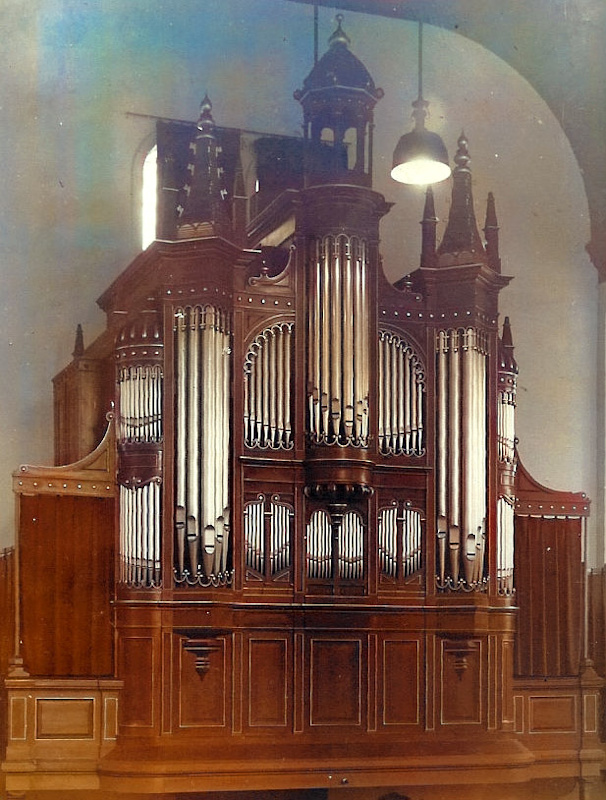
 The Jerusalem Church in Rotterdam-Kralingen was built in 1907 as a Reformed Church. In 1910, the company of P. van Dam from Leeuwarden installed a new organ in the church. The instrument had a very nice façade and a closed organ case. It was a very solidly built church organ with a mechanical action and sliderchests. The organ was inaugurated on October 21, 1910. In accordance with the style of that time, the organ had a romantic sound and was described in the press as solid. Adhering to the idea that mechanical organs function better, the Van Dam company installed a mechanical pipe organ with a classic front. This and other comparable organs that the company built in these years are an exponent of the traditional classical line that the conservative Van Dam family set out. For this reason, their organs are counted among the last from the traditional period of Dutch organ building.
Restoration 2023
The starting point is that the current construction, design and sound of the organ will in principle be maintained. Technical improvements ensure that the organ will function properly during use for the next 20 years. The Van Dam windchests are being restored. The electro-pneumatic action is replaced by a completely new electric action. The console will be overhauled, the keyboards will be restored and the playing aids such as the register crescendo will be discontinued. The leather of two bellows is renewed.
Laden


View the embedded image gallery online at:
https://vandenheuvel-orgelbouw.nl/en/cms/nederland-en/jeruzalemkerk-rotterdam-en#sigProId6ed49bb4cb
https://vandenheuvel-orgelbouw.nl/en/cms/nederland-en/jeruzalemkerk-rotterdam-en#sigProId6ed49bb4cb
Balgen


View the embedded image gallery online at:
https://vandenheuvel-orgelbouw.nl/en/cms/nederland-en/jeruzalemkerk-rotterdam-en#sigProIdd290692a98
https://vandenheuvel-orgelbouw.nl/en/cms/nederland-en/jeruzalemkerk-rotterdam-en#sigProIdd290692a98
Speeltafel


View the embedded image gallery online at:
https://vandenheuvel-orgelbouw.nl/en/cms/nederland-en/jeruzalemkerk-rotterdam-en#sigProIdd095996cc9
https://vandenheuvel-orgelbouw.nl/en/cms/nederland-en/jeruzalemkerk-rotterdam-en#sigProIdd095996cc9
Montage in de kerk


View the embedded image gallery online at:
https://vandenheuvel-orgelbouw.nl/en/cms/nederland-en/jeruzalemkerk-rotterdam-en#sigProIda185cbc395
https://vandenheuvel-orgelbouw.nl/en/cms/nederland-en/jeruzalemkerk-rotterdam-en#sigProIda185cbc395