Martijn van der Horst
Residence organ for sale (14/IIP)
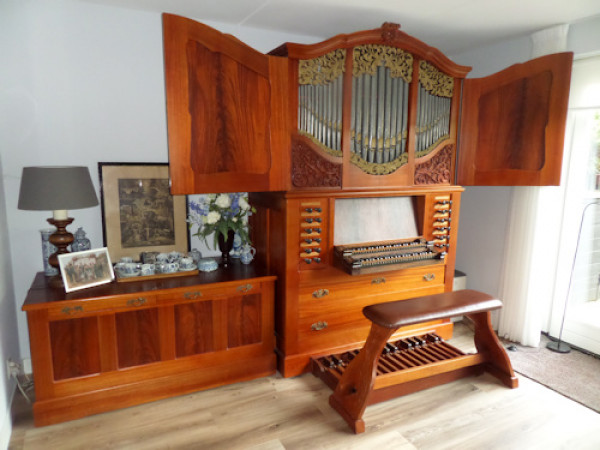
The organ was built during the period 1987~1989 by Louis Huivenaar (the well known reed-organ restorer located at Dieren, NL) for the residence of the Schalkoort Family. Louis Huivenaar partly used parts of used and historical materials in this instrument. In 2013 the organ builder carried out technical maintenance. The owner offers his pipe organ for sale because he can no longer use the organ optimally in his new terraced house.
The organ case is made of mahogany. The shaped key-cheeks are made of coromandel wood. The key coverings are made from bird eye maple and ebony. The coupling operation takes place by moving the cheeks.
Van den Heuvel-Orgelbouw was requested to find a suitable place for this organ. The organ is immediately available. The asking price of the owner is Euro 26,900. No VAT is payable on the purchase amount as the organ is sold by a private person! The costs for dismantling and transfer are at the expense of the buyer. If desired, Van den Heuvel-Orgelbouw can be of service to you.
Download the brochure for more detailed information.
For further information:
Jan L. van den Heuvel – Orgelbouw bv
Amstelwijckweg 44
3316 BB Dordrecht
T: 078 – 6179540
E:
G.A. Hazen (1986, 12/IIIP)
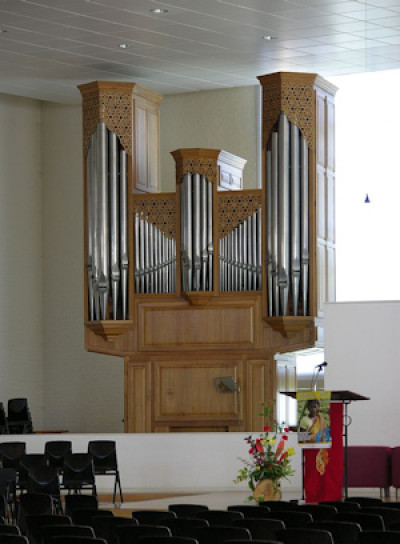
The Saint-Fransiscus church is a Roman catholic parish in Breda (NL). The building was designed by architect S.F. Steeneken in a sober modernist style. The church building will be soon given another function making the organ (G.A. Hazen, 1986) redundant.
Download the brochure for more detailed information.
For futher information:
Jan L. van den Heuvel – Orgelbouw bv
Amstelwijckweg 44
3316 BB Dordrecht
T: 078 – 6179540
E:
Hersteld Hervormde Gemeente, Nieuwaal (2023)
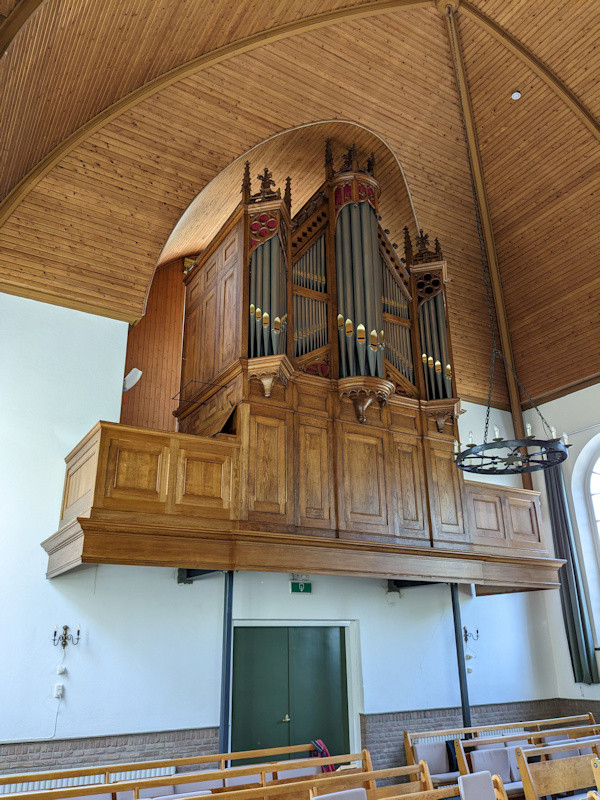
In 1909 the company of Maarschalkerweerd & Zoon built a new organ with a pneumatic action in the neo-Gothic chapel of the Sisters of the Good Shepherd in Leiderdorp. In 1967 organ builder Willem van Leeuwen installed a new interior in the beautiful organ case. In addition to the façade pipes, two stops were reused: the Holpijp 8' and the Roerfluit 4'. However, these were provided with new languids and lower cuts. The monastery closed its doors in 1971. Van Leeuwen subsequently transferred the organ to the Evangelical Lutheran Church in Den Helder. This church was also closed in 1990. The building then stood empty for several years. In 1995 it was taken into use as a Dutch Reformed church, but this church was also closed in 2013. In 2022, the Restored Reformed Municipality of Nieuwaal purchased the organ after our mediation. The organ is being overhauled and the organ case restored. The stoplist is expanded. An extra voice is added to each keyboard and pedal: Cornet IV, Dulciaan 8' and Fagot 16'. The high mixtuur composition is also adjusted and the conical Quint 1 1/3' is moved up an octave to make a Nasard 2 2/3'. The Pedal Quintadeen is replaced by an Octaafbas 8' of mahogany.
Laycock (1877, 11/IIP) organ
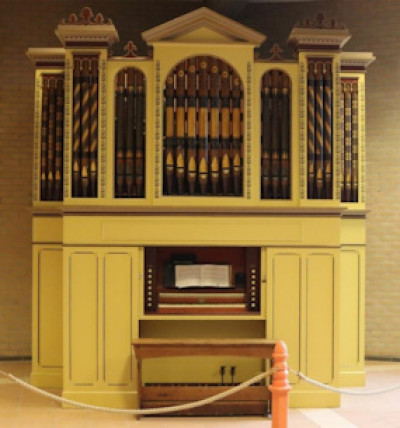
1877 this organ was built by John Laycock (1808-1889) for the Ickornshaw Methodist Church in North Yorkshire (UK). 1907 the organ was moved to the Carleton Methodist Church where it was used up to the moment the church was closed in 1999. At that moment the organ was bought by J.L. van den Heuvel-organ builders in The Netherlands. At that moment the organ was completely original except the electric blower (the hand pump installation is still present but is no longer in use). 2002 the organ was located in the auditorium of the Jacobus Fruytier high school in Uddel (NL). The owner has asked Van den Heuvel to find a suitable new location for this beautiful instrument. the organ has been dismantled and assembled in one of the assembly halls of the organ builder in Dordrecht. There you can see and play the instrument!
Download the brochure for more detailed information..
Further information:
Jan L. van den Heuvel – Orgelbouw bv
Amstelwijckweg 44
3316 BB Dordrecht
T: 078 – 6179540
E:
Hervormde kerk Hagestein (2022)
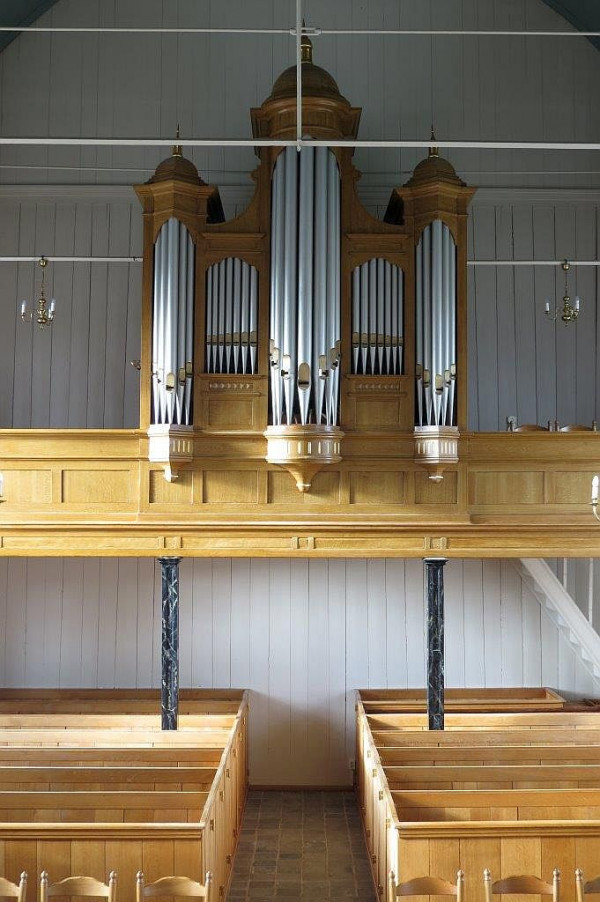
The De Koff organ of the Hervormde Kerk in Hagestein was inaugurated on November 18, 1920. This completely newly built organ replaced an old cabinet organ, which was in poor condition. The soberly designed organ case is beautiful on the organ gallery and in the church. During the last church restoration, the pine organ case with gallery, along with other parts of the church interior, were repainted in oak imitation. The entire interior has thus become a beautiful visual unity. The De Koff organ was restored in the years 1968-1969 by organ builder A.H. de Graaf from Leusden.
At the beginning of 2021, a plan was drawn up to restore the organ. The Bourdon 16 will return to the manual and the original transmission will be restored. The Octaaf 2 which took the place of the Bourdon 16 will be moved to a newly made side block at the front of the windchest.

In the first week of January 2022, the organ was disassembled and transferred to the workshops in Dordrecht. The restoration of all the parts has started there.
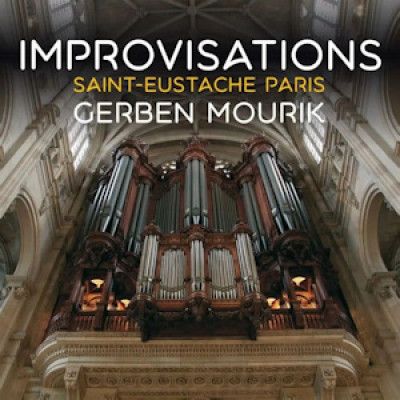
Gerben Mourik - Improvisations - St. Eustache, Paris
Pels (1967, 7/IP)
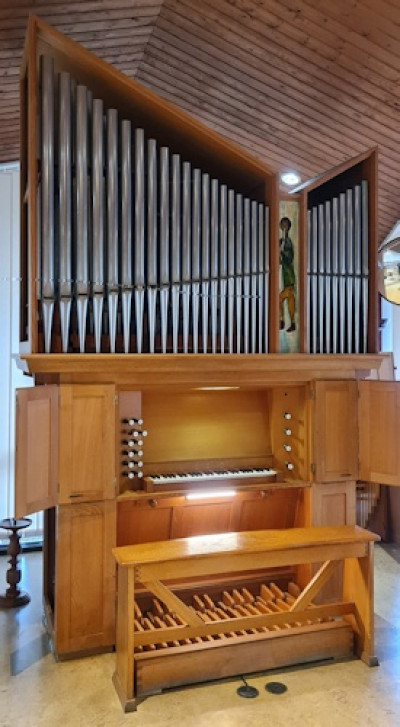
The Bernard Pels & Sohn company built this organ for the chapel of the Overduin care center whereby the famous Dutch organist Feike Asma acted as consultant. On July 14th, 1967 Feike Asma inaugurated this pipe organ. The Pels-organ, which is in good condition, was well maintained by this company until the bankruptcy of Pels & Van Leeuwen in 2017. The organ is dismantled and assembled in the assembly hall of the organ builder in Dordrecht. There you can see and play the instrument!
Download the brochure for more detailed information.
For futher information:
Jan L. van den Heuvel – Orgelbouw bv
Amstelwijckweg 44
3316 BB Dordrecht
T: 078 – 6179540
E:
Pels organ (1964, 7/IIP)
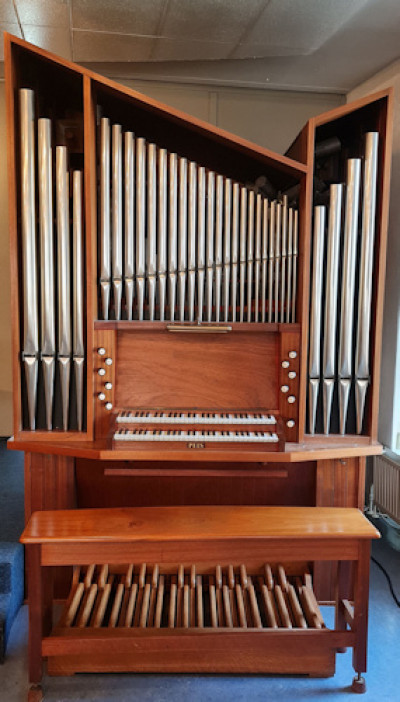
1964 the organ building company Pels & Son from Alkmaar (NL) built this new organ for a chapel in Bergen, North-Holland. 2010 the organ was sold to the auditorium De Dorsvloer in Spijkenisse (NL). Organ builder Pels & Van Leeuwen worked in the organ and the stop list was changed (Mixture became Octaaf 2’) as well as the pipe scaling of the Prestant 4’ and Octaaf 2’ was made wider to the treble. In January 2011 followed the inaugural concert. The auditorium De Dorsvloer was sold recently and J.L. van den Heuvel-Orgelbouw received the order to find a suitable new room for this nice instrument. The organ is dismantled and stored in the organ builders storage in Dordrecht.
Download the brochure for more detailed information.
Further information:
J.L. van den Heuvel – Orgelbouw bv
Amstelwijckweg 44
3316 BB Dordrecht
T: +31 78 617 95 40
E:
Gerben Mourik - Caleidoscoop