




Martijn van der Horst
Hersteld Hervormde Kerk, Ridderkerk (2021)
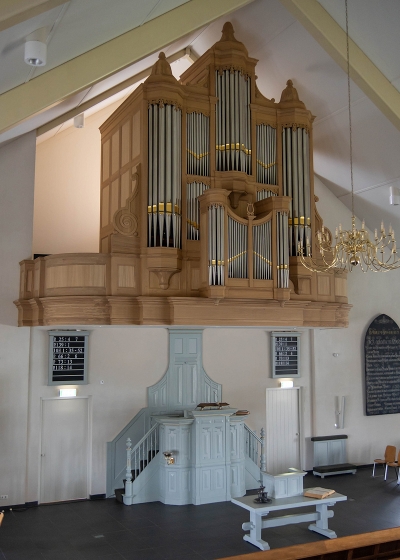
The organ in Sionskerk of the Hersteld Hervormde Gemeente in Ridderkerk will be the third organ that we construct for Ridderkerk. In 1972 the organ of the Reformed Singelkerk (32/IIIP) was completed. In 1980 we placed a French-romantic organ (34/IIP) in the Bethelkerk of the Netherlands Reformed Congregation

The Sionskerk was opened in March 2015. The church building, built in brick in classical style, designed by architect Born, can accommodate around 700 people. The Van den Heuvel organ gets a place above the pulpit. The design of the organ case, just like the pulpit, is in late nineteenth-century, early twentieth-century style. The organ case and the gallery will be made of oak.
The instrument will have 29 speaking stops on Great, Swell and Pedal. We expect to be able to deliver the organ in 2021.
Latest photo update: 3 december.
Hervormde Kerk, Werkendam (2020)
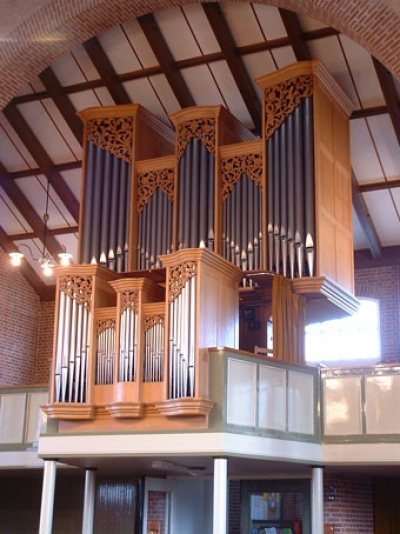
When the old village church of Werkendam was bombed at the end of the Second World War, the Witte organ from 1865 was also destroyed. The new church, built in 1952, was designed by the architects Nielsen and Spruit. One year after the construction of the new church, the Willem van Leeuwen firm in Leiderdorp was commissioned to build a new mechanical organ (opus 300) with a vertical slider system. Willem van Leeuwen was already oriented towards the historical organ in this time in the organ movement and it is special that he also builds a mechanical organ with a great, a positive and a pedal. Unfortunately the used the material was of poor quality. The organ case, for example, was made of spruce wood studs and frameworks with thin plywood panels.
 |
On the left you see the vertical slider system as used in Werkendam. At the bottom of the picture is the channel grid with a solid (!) wooden cover plate. The slider system is placed on top of that. This consists of a vertically placed beam with a pertinax slider on each side. Above the moving slider a fixed pertinax slider has been placed to compensate for the height difference. A cap clamped against the sliders, which consists of a pertinax bottom plate with a bakelite cap. When a key is pressed, the wind from the cancel flows into the vertical beam, through the movable slider, flows through the cap back into the beam to flow up into the pipe grids.
|
At the time of delivery, 8 of the 20 stops were reserved. In 1963 Van Leeuwen added two stops: a Fagot 16' was added to the Pedaal instead of the originally planned Octaaf 4' (which would already have been replaced by a Schalmei 4' in 1958), and a Roerfluit 4' was added to the Rugwerk, placed in place of the planned Quintadeen 8 '. On the Hoofdwerk a Cornet III took place instead of the planned Dulciaan 16 '. The following year, Pels & Van Leeuwen will fill the remaining vacancies.
In 1972 the organ was restored by Pels & Van Leeuwen, where wind chests and mechanisms were partially restored and the organ got a new oak case with a more elegant design. Three new stops were also placed. On the Pedaal the Spitsgedekt 16' was replaced by a oak Subbas 16' from Van Gelder, from the Willemskerk in The Hague, on the Hoofdwerk the Trumpet was replaced. Around 1980, the Cornet was replaced by a 5-ranked specimen from Groot-Ammers, which was put in storage. In 1974 the blind carvings were applied and the organ was completed under the advice of the then organist Frans van Tilburg, who played the organ from 1957 to 1984.
Blank (1976, 17IIP)
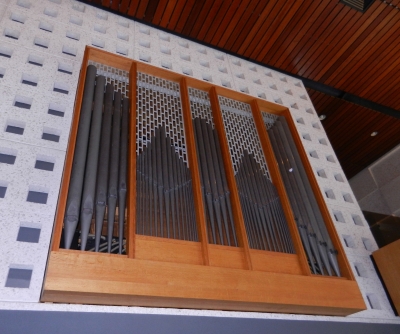
In 1976, the firm K.B. Blank & Zoon built a new organ (II / P, 17 voices) in an auditorium of the Nieuwe Westerbegraafplaats in Amsterdam.
The fraçade design took full account of the specific architecture of the auditorium. The organ was built behind a wall, only the façade protruded through it. When rebuilding the organ, the arrangement and the organ case will therefore have to be revised. This gives the buyer the necessary freedom in terms of arrangement and design. The organ was disassembled by Van den Heuvel-Orgelbouw and stored in Dordrecht.
Further information:
J.L. van den Heuvel – Orgelbouw bv
Amstelwijckweg 44
3316 BB Dordrecht
T: +31 78 617 95 40
E:
Hervormde Kerk, Nunspeet (2020)
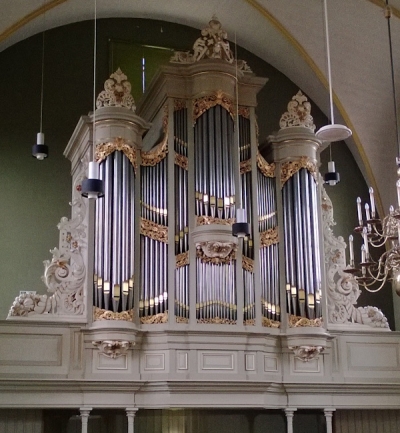
In 1872 the firm of L. van Dam and Sons placed a new organ with two manuals and pulldown pedals in the Dorpskerk of Nunspeet. It had 17 speaking stops. It was originally placed at the west side of the church. At the begin of the 20th century the firm of Van Dam & Bergmeijer replaced the Clarinet with a Voix Céleste. After the enlargement of the church the firm of Leeflang relocated in 1960 the organ into the new part of the church.
In the years 1967/1968 the instrument was adapted to the spirit of that time and enlarged. Consultant was Wim van der Panne. A independant pedal division was added, pedalcouplers, a new windsupply system with movable windchests bottoms. The windchests grids recieved ply wood toppings on both sides. Sliders were renewed with a spring system. Also the Hoofdwerk windchest was re-organized wereby the Boudon 16 and Violon 16 were removed to make place for a Mixtuur IV-VI. The Voix Céleste was also removed and its spot was taken by a Cymbel and a narrow scaled Dulciaan both on its own slider. Key- and stopaction were modernized. The organ was inaugurated on January 25, 1968. It was played by Wim van der Panne and G. van Campen.
In December 2017, the contract was signed for a complete restoration of the organ. Organ consultant Herman G. Kamp will supervise the project. In addition to the necessary restoration work, necessary sound improvements are also being made. The original sound of the instrument will be partially restored by undoing the works that have seriously affected the sound. Later (valuable) additions will be maintained and, where necessary, improved. The work will be inspired by Van Dam's original concept, but without extensive reconstruction or copying of other Van Dam instruments.
Hervormde Kerk, Yerseke (2019)
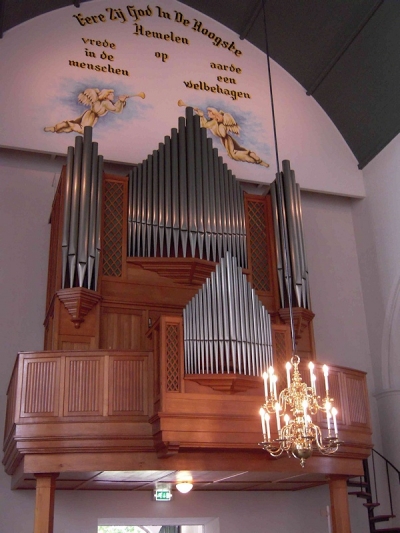
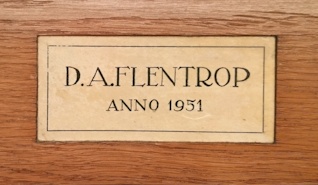
The Flentrop company built a new organ in 1951 for the Reformed Church in Yerseke. The façade is a design by the architect J.W. Janzen. The instrument in the Reformed Church of Yerseke is a very solidly built organ. It was designed and built at a time when a major change in organ building took place (a refocusing on the mechanical "baroque" organ type). It is one of the earlier organs in which Dirk A. Flentrop presented his knowledge for this type of organ that he built according to the mechanical slider chest system. This organ has a beautiful sound and the pipe scaling is generous, it is definitely not a neo-baroque sound.
Despite the very characteristic elements and qualities, there are also weaker points. The quality of the reed stops is unfortunately below the level that is nowadays considered desirable. The sound development is certainly characteristic of the construction period, but this is nowadays done differently (more 'user-friendly' and more fitted to contemporary use in the worship service).
In 1975/76 the organ was transferred by the builder to the new west wall of the church. A pneumatic pressure Tremulant was built in by Flentrop and the reed stops were re-worked. The Nijsse company carried out major maintenance work in 2007. Whereupon the Spitsgedekt 16 of the pedal was replaced by an oak Bourdon 16. Again, the reed stops were re-worked. Unfortunately without the desirable result because the reed stops were still unstable.
Hersteld Hervormde Kerk, Lunteren (2019, 46/IIIP)
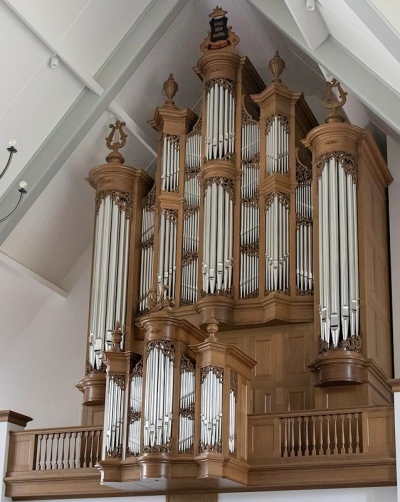
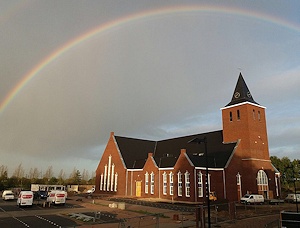
The Hersteld Hervormde Gemeente is currently building a traditional church seating 1.200 people. The design is by architect Marco Born. Already in 2008 Van den Heuvel Orgelbouw was involed in the plans of the church to get to an optimal acoustic church building.
The organ will have 3 manuals and pedal and includes a 14 stop swell division. The sound will be wealthy, solistic and singing: a real 'Dutch' organ optimal for community singing but also fit for as a solo instrument. The classical organ case designed by Van den Heuvel Orgelbouw will be crafted of first class European oak.
Last picture update: July 12th.
Maranathakerk, Dinteloord (2018)
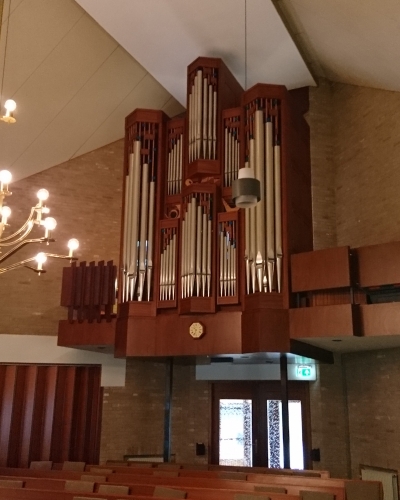
After the construction of a new church for the Reformed Congregation in Dinteloord in 1982, the existing positive of Leeflang from 1976 proved to be too small for the church. The Leeflang company was subsequently commissioned to build a larger organ. Consultant was again Arie J. Keijzer. The architect of church, J. Valk from Soest, designed the façade. The organ was inaugurated on 4 May 1984 with the consultant at the organ.
in 2018 J.L. van den Heuvel Orgelbouw was commissioned for the repair works. Hereby the organ was cleaned, the windsupply was re-leathered, the voicing was corrected and the mechanical action was reworked and re-adjusted. The Sesquialter consisted of a conical Nasard and a Tierce in flute scaling. This stop was split into a separate Nasard 2 2/3 and a Terts 1 3/5 each with its own slider and stop knob.
Stedelijk Museum, Schiedam (2017)
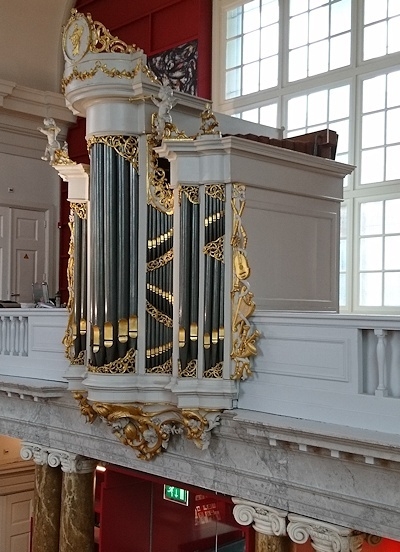
From Guesthouse to Stedelijk Museum
The central hall of the Stedelijk Museum of Schiedam was formerly used by the Waalse Gemeente. The building was also known as Gasthuiskerk because it was part of the Sint Jacobsgasthuis.
Organ
In 1773 organ builder Hess constructed an organ for the church. It was inaugurated on 9 September 1773. The organ was played by Joachim Hess, organist of Gouda, and Mister Hagen jr.
Recently we restored the organ which was in unplayable condition. Consultant during the works was Arjen Leistra, city organist of Schiedam and also organist of the Grote Kerk of Schiedam. The restoration works included the two large wedge bellows, cracked wind trunks, optimization of the wind supply, metal and wooden pipes as well as the action. The voicing was only corrected where needed. Also a humidifier was installed.
Hersteld Hervormde Kerk, Ouderkerk aan den IJssel (2017/19, 38/IIIP)
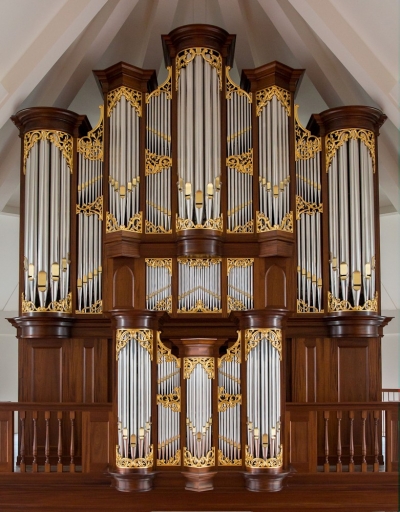
In 2016 the “Hersteld Hervormde Kerk” is building a new 900 seat church. The traditional design of this church is made by the well known Dutch architect Marco Born.
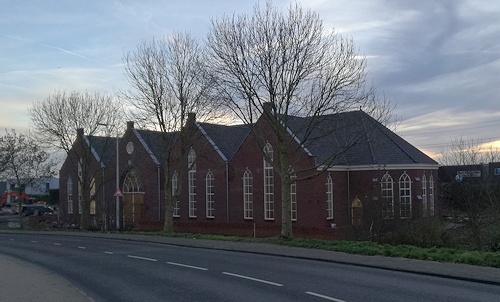
The church committee decided to install a fine pipe organ. Since many churches are closing in the Netherlands the best quality organs are quite often sold to Van den Heuvel-Orgelbouw. Van den Heuvel (trained by Dirk A. Flentrop) bought the last few years, among other organs, 5 important Flentrop organs, and just purchased a well known Flentrop-organ from the Maranatha-church in Amsterdam. The measures of this organ were suitable for the church in Ouderkerk. The customer however requested Van den Heuvel to make important improvements, alterations and to include additional (wider scaled) stops, as well as a completely new traditional organ case design with wood carvings. The organ has to be delivered in 2017.
The Flentrop organ had a traditional winding system with 4 folding bellows. The windsupply is redesigned and includes an additional wind motor and one additional bellow. The Flentrop bellows are re-leathered, also the wind trunk system will be renewed.
Hervormde Kerk, Scherpenisse (2016)
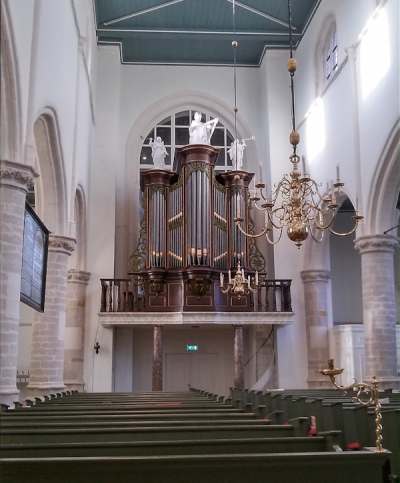
Church
Already in 1203 the a church was mentioned in the archives. Todays church dates from the fifteenth century.
The first details of a church or chapel of Scherpenisse date back to 1203. This church was dedicated to the Virgin Mary and belonged to the deanery South Beveland and chapter of Old Minster in Utrecht. In the church were three chapels; dedicated to Saint Barbara, the Holy Cross and St. John.
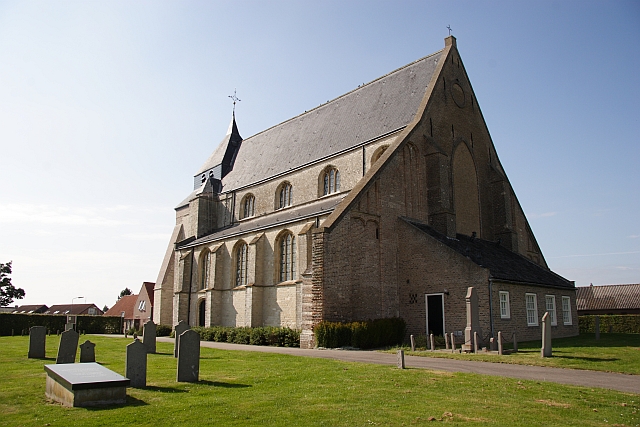
The current Reformed Church of Scherpenisse dates from the 15th century. Around 1462 a new choir was built. The aisles of the church arose probably around 1500. The aim was to build a high church tower. However, it has never been higher as it is now. The construction was halted, possibly related to a lack of funds and the floods in the 16th century as the St. Felix's Flood and the Saints flood.
The transept and the cancel of the church were so dilapidated in the 17th century that the collapse of the chancel into the church threatened the church in 1685. The situation remained poor until the mid-18th century. After stone and lime fell from the walls, the pulpit and the seats were transferred into the nave. Two years later fell debris on the pulpit, Pastor Matthias Janssen wanted to do no more in this dilapidated building. Money for the restoration of the church was missing so the choir and transept were demolished in 1753. A wall at the former separation of nave and choir now closed the church. It was a window until in the 70s of the 20th century when it was bricked. In the church there are many 17th-century objects such as the pulpit and a chandelier. The oldest gravestone dates back to 1441. The oldest of the three church bells was cast in 1484 by bell founder Sijmoen Waghevens Mechelen.
In 1971-1974 the church was restored, followed by the most recent church restoration in 2009.