Martijn van der Horst
Dendermonde (2016)
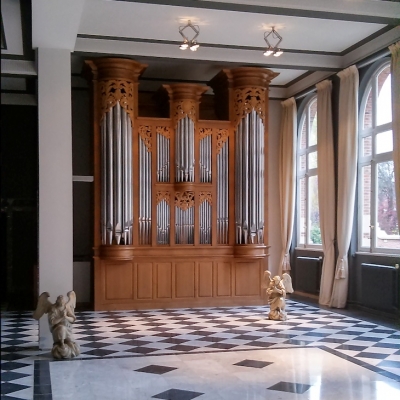
<p>In 2016 the renovation works on the Pels organ (33/IIIP) in Dendermonde (Belgium) were completed. Besides a complete re-voicing including recomposition of the mixtures and rescaling of some stops the unreliable electric action was renewed. Also the ergonomics of the console were improved and new keyboards, pedal contacts, stopjambs and draw knobs, swells, pistons, displays, combination system and midi recorder were installed.</p>

Van Oeckelen (1857, 19IIP)
Petrus van Oeckelen was born in Breda in 1792 as the son of the instrument maker and organ builder Cornelis van Oeckelen and Elisabeth Coenen. Around 1808 he was appointed city carillonneur of Breda. In 1810 he moved to Groningen, where he was appointed carillonneur of the Martinitoren. In 1837 he established himself as an organ builder in Harendermolen, near Glimmen. In that year he also took over the company of the deceased organ builder Johannes Wilhelmus Timpe. Petrus married Joanna Maria Theresia Auwerda on 30 June 1825 in Groningen. Six children were born of this marriage, three of whom, like their father, became organ builders. One daughter married a pupil of her father, the organ builder Jan van Loo, who mainly worked in Overijssel. Petrus van Oeckelen died in August 1878 in Glimmen, two days after the age of 86. Two of his sons, Cornelis Aldegundis (1829-1905) and Antonius (1839-1918), continued their father's business. A third son, Henderikus (Henricus) van Oeckelen (1835-1894), was also an organ builder, but was not part of the family business.
Organ history
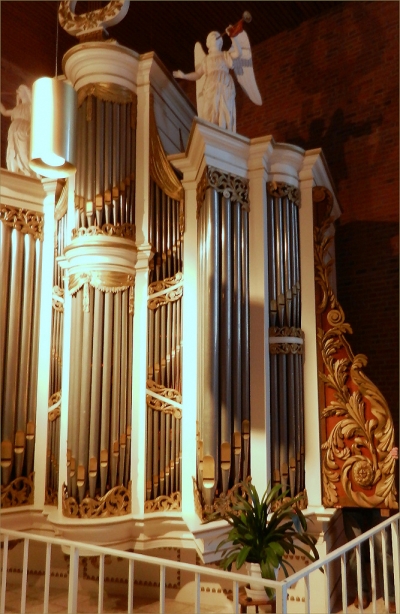
On May 32th, 1857, the organist and organ consultant S.W. Trip performed the opening recital on the by the Groningen organ builder Petrus van Oeckelen built “new” organ. Van Oeckelen incorporated parts from older organs in this instrument.
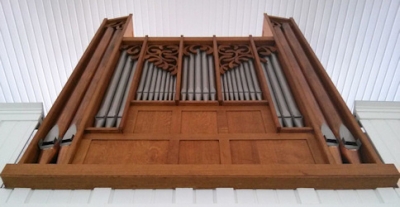
In 1854, Petrus van Oeckelen reconstructed the organ in the Martinikerk Groningen, and during this major work, he constructed a new (larger) sound board for the Great (Hoofdwerk) which incorporated enough space for a 16’ stop. The original sound board, made in 1729 by the employees of Franz Casper Schnitger (Franz Casper died before he could complete the work in the Martinikerk, so Albertus Anthonie Hinz completed the job in 1720) was taken over by Petrus van Oeckelen. In 1857 Petrus delivered a “new” organ in the Wersterkerk in Harlingen. In this instrument he re-used the F.C. Schnitger sound board! At that time the compass still was c-c3 = 49 notes. The sound board of the Bovenwerk is built by another builder. For the organ case he re-used a design he made in 1852 for the church of Usquert. The Westerkerk in Harlingen dates from 1650 and was demolished in 1896 due to dilapidation. At that time the organ was sold to the Reformed church of Oude Pekela. The expansion of the manual compass from 49 to 56 notes was made in the 20th century.
The well known Schnitger specialist/organ builder Bernardt Edskes has thoroughly examined the sound board in the Van den Heuvel workshop in Dordrecht and confirmed that this is the original Hoofdwerk sound board constructed for the famous Schnitger-organ of Martinikerk, Groningen (NL).
The church of Oude Pekela, later named Reformed Church, was founded in 1861 as a Christion separated community. The striking building served until 1978, in that year the church was closed due to dilapidation. A new modern church was build, named Het Anker, and the organ was situated on the ground floor instead of on a balcony as it was before. The carvings at both sides of the organ case disappeared to the attic. Bernard Koch from Apeldoorn carried out the transfer andwhat he mentioned “the restauration”. The organ case was originally painted oak imitation, and was painted white in 1980. The side ornaments of the case however still have the original color scheme.
Download the brochure for more detailed information.
For futher information:
Jan L. van den Heuvel – Orgelbouw bv
Amstelwijckweg 44
3316 BB Dordrecht
T: 078 – 6179540
E:
Evangelische Kirche, Siegburg (2015)
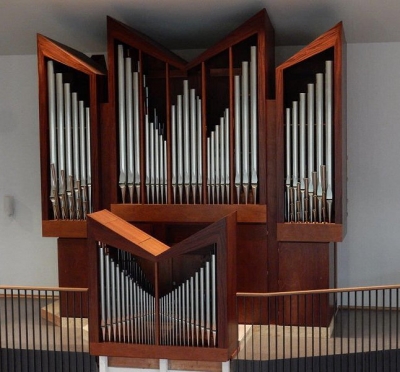
In 1960 D.A. Flentrop built this 26-stop organ organ for the Reformed church in Bloemendaal. The inauguration took place on December 21st 1960. In 2001 Flentrop restored the instrument. The instrument is well known from the weekly Radio-broadcasting on Sunday. Recently the parish moved to another building.
In 2014 the organ was purchased by J.L. van den Heuvel Orgelbouw b.v. and has found a new good home in the Evangelische Kirche of Siegburg (Germany). The church gallery will be enlarged to accomodate the organ.
The organ was fully restored and enlarged by a Prestant 16' on the pedal. It is placed on new windchests behind the organ with it's own windsupply. Additional offset chest were made for the low 10 pipes of the Subbas. The Fagot was renewed and the Pedal mixtuur replaced with a new Trompet 8'. A complete re-voicing was prepared at the workshop and will be completed on location.
Manfred Schwartz, official organ consultant for the Evangelical Churches in Rhineland, has been appointed as consultant.
Opheusden, Netherlands Reformed Congregation (2015/8, 40/IIIP)
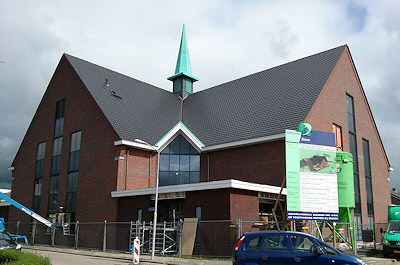
The Netherlands Reformed Congregation of Opheusden constructed on the same location as the old church a new church seating 1750 people after the design of Van Beijnum Architects.
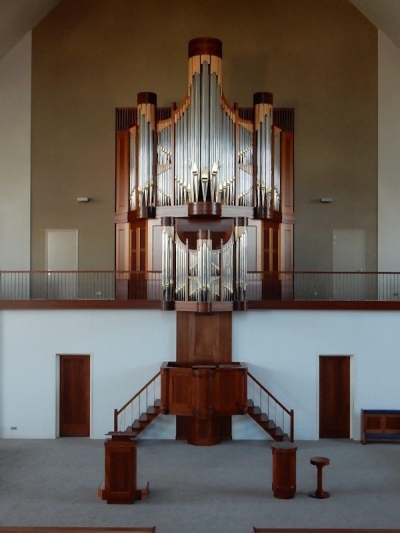
The two manual organ by Van den Heuvel was inaugurated in march 2002. It had 29 stops on Great, Swell and Pedal. The organ is be enlarged with a positiv and a open Quintbas 10 2/3' on the Pedal.
The façade was designed for the corner placement of the organ in the former church. The organ will now be placed on a gallery. The width of the new church allows a good view on all sides of the organ case with its three round towers and 12 pipe fields.
Also, the pulpit, the lectern and the font of your own design has been manufactured by us.
St. Aloysius Church, Glasgow (2015)
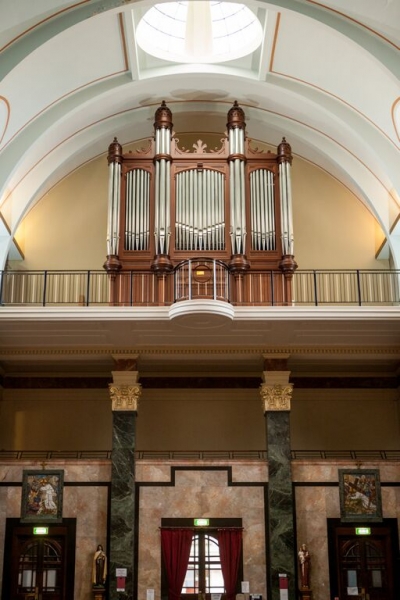
The Van den Heuvel organ was originally built for the Duke's Hall in London. Due to a large donation it was replaced by a larger organ and the organ was taken back by Van den Heuvel.
Van den Heuvel organ was purchased in 2014 by the board of the St. Aloysius College in Glasgow.
In spring 2015 the choir gallery in the nave of the beautiful St. Aloysius Church has been enlarged and adapted for the new organ. Also the interior of the church was repainted. Afterwards the installation of the Van den Heuvel organ followed. The organ will be used not only during church services and concerts but also by students of the St. Aloysius College and by students of the Royal Conservatoire.
Parafia rzymskokatolicka pw. bł. Anieli Salawy, Krakow (2015)
Hersteld Hervormde Kerk, Gameren (2014)
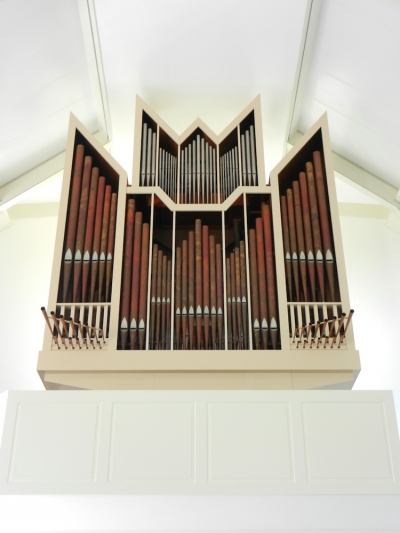
Christelijke Gereformeerde Kerk, Vianen (2014)
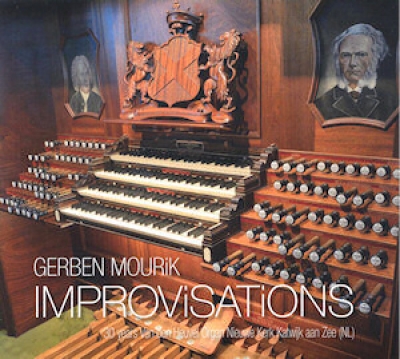
Gerben Mourik - IMPROVISATIONS - 30 years organ Nieuwe Kerk Katwijk aan Zee
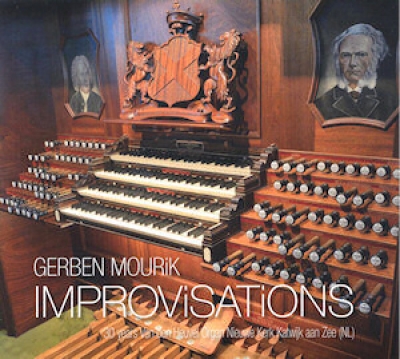
Gerben Mourik - IMPROVISATIONS - 30 years organ Nieuwe Kerk Katwijk aan Zee